
The Winter Sky
On death as form

You’re reading the quarterly newsletter of The Dream Side, a collective of friends, novelists, and teachers: Meng Jin, Rachel Khong, Susanna Kwan, and Shruti Swamy. We’ll send this newsletter at the start of each new season, and share craft essays and writing prompts in addition to our forthcoming offerings.
Interested in renewing your writing practice and resetting your attention? Join us in 2026 for GREEN HOURS, a five-night generative writing retreat in Oregon’s Umpqua National Forest.
It’s winter and the waters where I swim in the San Francisco Bay are properly freezing. The year is ending. The days are ending; whenever I look up the winter sky seems already to be draining of its clean, cold blue. I’m approaching the end of a novel I’ve been writing for half a decade. The wide world feels as if in a long season of loss; everywhere I turn there is someone, some place, some way of being to mourn. In these short, sharp, cold, and always-ending days, I’m often thinking about endings, death, and passing.
If you asked young-writer-me ten years ago what I wanted, I might have mustered up some bravada to say, “To write something that lasts.” Now I’m not so sure. Now I don’t know if anything lasts—or if an unchanging and fixed immortality is worth seeking. I’ve written some things since feeling that way, two books, and I don’t know if they’ve lasted, even for me. Instead I feel like these lines by Richard Siken: “It’s a small window, the span of time in which we get to say what we know. I took a picture of myself by the side of the road. Strange picture. I don’t look like that anymore.” How wonderful, I think, that I don’t look like that anymore. I’m not a wax statue. I’m a living, changing, dying human being.
Now I want my writing not to step out of time but into it. Perhaps it’s my new swimming habit, all the hours I’ve spent in and with the sea, my growing familiarity with her unceasingly forming and disappearing waves, which will patiently wash away all the marks we make on land. The sea teaches a consciousness that poet and painter Etel Adnan calls “a reality that is the awareness of the passing of things, and that itself passes away.” Now I’m more interested in now, this time, this moment that is already slipping away and generating a new moment that becomes a new now. How can I use my writing to enter into this propulsive and endless movement, to speak to now and hear it speak back?
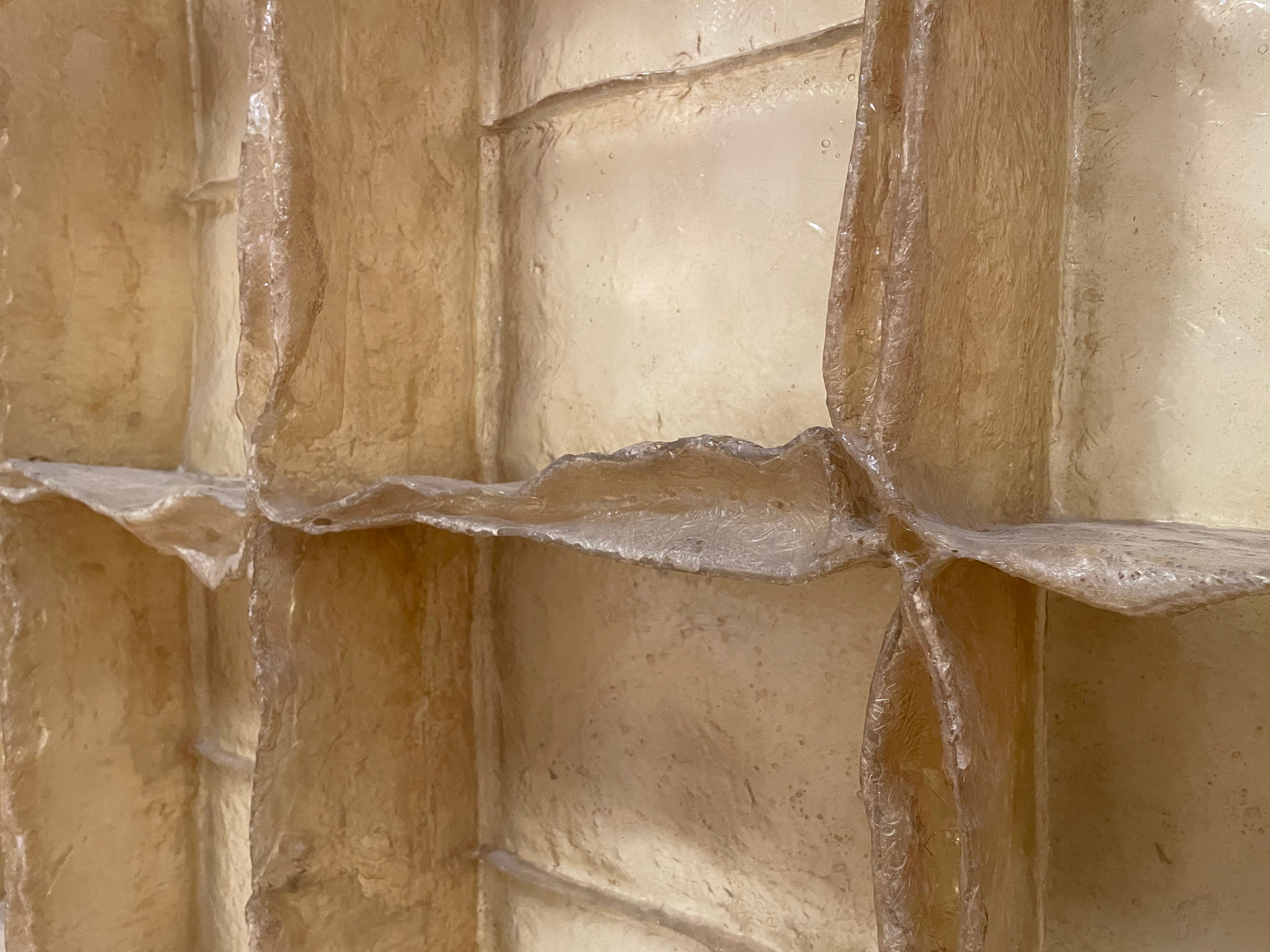
Sculptor Eva Hesse described the marriage of process and form in her art as “a total image that has to do with me and life.” Hesse made weird, tactile sculptures from industrial materials such as latex, plastic, and fiberglass, imitating processes of mechanical reproduction. From these deathless, lifeless materials, she coaxed organic, spontaneous forms. A recent documentary shows how she relished the act of making, taking pleasure in manipulating, handling, and playing with these strange new materials, in seeing what they could do, what forms would arise from their time spent together. Hesse knew that her sculptures would degrade, get brittle and dirty over time, be a headache to preserve. But the sculpture wasn’t the whole point: “The art was in the making. The artifact was what was left over.”
Eva Hesse created prolifically, joyfully, until her death at age 34 of brain cancer. What hangs in museums are her leftovers, the evidence of creation. The art was her life.
Death is evidence of life, just as a sculpture is evidence that art happened. Turn this around and you can see how the form of a work arises from the process of making it in a “total image.” Hesse’s sculptures were the death of her art, the ending of their making. Or, as atemporal physicist Shevek says in Ursula K Le Guin’s The Dispossessed, “All you have to do to see life whole is to see it as mortal. I’ll die, you’ll die; how could we love each other otherwise? The sun’s going to burn out, what else keeps it shining?” The sun’s burning out is its shining. Dying is the activity of life. Death is what gives life form.
As a writer, my material is language. My writing is an artifact of my days spent alive playing with language, manipulating it, seeing what it’ll do, coming to a spontaneous compromise between what I imagined and what I ended up being capable of, what my material allowed me to make.
The dream of the artifact can act backwards on the present life. I have experienced this as a gift:
In order to write, I try to create in my life conditions of spaciousness, freedom, and play. In order to write, I try to live open to experience, connection, pleasure, feeling, and beauty. I try to enter a state that is in contact with—or at least holds the door wide open for—what Rachel called, in her talk at our Rewilding Craft retreat, “the mystery.” I fail all the time in these efforts but it’s what I strive for and it’s what works best to make the writing good, much better than hammering principles like “show don’t tell” or “don’t use too many adverbs” into my sentences. What I’m able to write is not the result of labor directed towards the production of a work, but rather the language-transformed, form-constrained record of the life I made.
Let me give an example. The novel I’m ending writing now has a utopian element. Because I’m writing this book, all my senses are open to utopian ideas—which is to say I’ve got my antenna tuned to hope. I’m alert to hope and especially to wild, creative hope on a social level, to different ways of living and alternative worlds, little pockets cut out from mainstream society, in conversations with friends and strangers, in the books I read and the experiences and spaces I seek. I’ve made it a point to investigate every buzz on the antenna, to accept random encounters as gifts, and to try to put them into my book. (Speaking of—if you’re reading this and have your own utopian interests, tell me in the comments below?) Form acts in both directions. I set the specific questions of my novel in order to open these doors of investigation in my life. It’s not a coincidence that in politically scary and depressing times I’ve tuned my antenna towards hope. Does it matter if the book that’s made from the momentary zaps on this temporary antenna lasts? Making it is already enriching my life.
In Eva Hesse’s words: “Life doesn’t last. Art doesn’t last. It doesn’t matter.” It doesn’t matter, because we will live, we will make art anyway.
Writing prompt: Transform right now
What is passing, what is changing, what is coming to life and dying, what new life is emerging out of that death, the death Hélène Cixous calls the “young, present, ferocious, fresh death, the death of the day, today’s death…that comes so suddenly we don’t have time to avoid it”? What mood or epiphany or obsession feels RIGHT NOW like the most important thing? For one week, take a few moments to notice your current pressing observation/question. This can be very big or very small (the crow outside my window, the color of the sky, my chronic pain, the question how should I live?). Do this at least once a day or even better, multiple times, keeping a small notebook nearby for whenever a STRONG FEELING strikes. At the end of the week look back on your notes. Notice how your urgency moves and changes and cycles.
Go a step further. Next week, challenge yourself to put your RIGHT NOW FEELING into your RIGHT NOW WRITING: whatever you happen to be writing right now.
Or perhaps you are the type of person (like me) who is always working on many things at once. Use your RIGHT NOW FEELING to direct and focus your energy. After you notice your RIGHT NOW FEELING, identify a piece of writing (a story idea, a chapter of a novel, that poem you’ve been thinking about) that has the best chance of expressing or containing this passing feeling.
The Dream Side on transformation
Susanna: Lately I’ve come to understand art as a net that catches flares of the infinite. I knew this before, but subconsciously. Most days I register these flares and sometimes I can draw them down to the page with language—not to fix or fasten (impossible) but to mark the transmission that came through me. Beans that look splashed with paint, persimmons glowing red, sparkly spiderwebs. Cables hand-knitted into the wool sweater I wear each winter, the same pattern that kept fishermen warm a hundred years ago. Or when it’s 50 degrees in my apartment and my legs mottle to the shape of the sprawling vascular system under my skin and my breath makes brief clouds in the air. Or when my friend plays a chord progression that matches some mechanism inside me and makes my body hum. (Carl Sagan always in my head: “We are star stuff!”)
Shruti: I’ve been climbing into my memories of my childhood, walking around my childhood home in my mind, narrating letters to my childhood self, the wild girl who spent summers barefoot, roving around the neighborhood, hair messy despite my mother’s best efforts, draped in cats. Where did she go? A couple days ago I happened upon a folder of work over a decade old that I did for my experimental fiction class in graduate school—work produced under the spell of these weirdo writers and as loose and free as I have ever seen myself on the page. Is she still there, too? Did I tame myself, did I lose something, I wonder, remembering these past selves and lives—but I know I haven’t lost them, I carry them too. So I am undomesticating myself, at least, in my writing, trying to conjure these selves and let them speak.
Rachel: Writing—as airborne and ethereal as it sometimes seems, the invisible, electrical work of synapses—strikes me as inseparable from the mortal body. For me writing is so much about the “felt sense,” as coined by Eugene Gendlin (I have been reading all of his works): that preverbal, pre-thinking, bodily sensation that a sentence or word is the right one. That enigmatic feeling of rightness in the organic body, like a settling or an opening. As I’ve been learning and teaching about writing imaginatively, I’ve come to believe that imagination and lived, sensory experience exist in a feedback loop. Experience creates imagination; imagination creates experience, which creates imagination again. In biology, feedback loops can be positive (amplifying the system) or negative (inhibiting the system). Where experience amplifies, so much of our current technology inhibits. Life mediated through a screen resembles but is not exactly life. Images are poor substitutes for experience itself. (They might seem to enlarge it—put us in places far flung, make us intimate with atrocity—but they are not experience.) Images stay static, arrested, unlike each of us who is moving through time, and toward death. At the end of every old year—or the beginning of every new one—I choose a word for the year ahead. My word for 2025 was “flow” (a fitting reminder during an often frustrating year of stops and starts). I’m thinking 2026 will be “experience.” More actual living, and less of the simulated stuff.
Can you think of a time when your writing felt like an artifact of your being alive? When your process entered totally into the final form of your work? When the dream of what you were trying to make turned around and acted on your life? Tell us about it in the comments.
Upcoming Offerings from The Dream Side
Winter passes and spring brings renewal. This spring, join us in the lush, riverine landscape of Southern Oregon for GREEN HOURS, a five-night generative writing retreat at The Steamboat Inn, from March 29 to April 3. With daily craft talks on rivers, rocks, trees, interconnected landscapes, and the inner landscapes of our dreams, GREEN HOURS is designed to renew your writing practice and reset your attention, by creating space for deep connections to the natural world and to one another. Reserve your spot today.
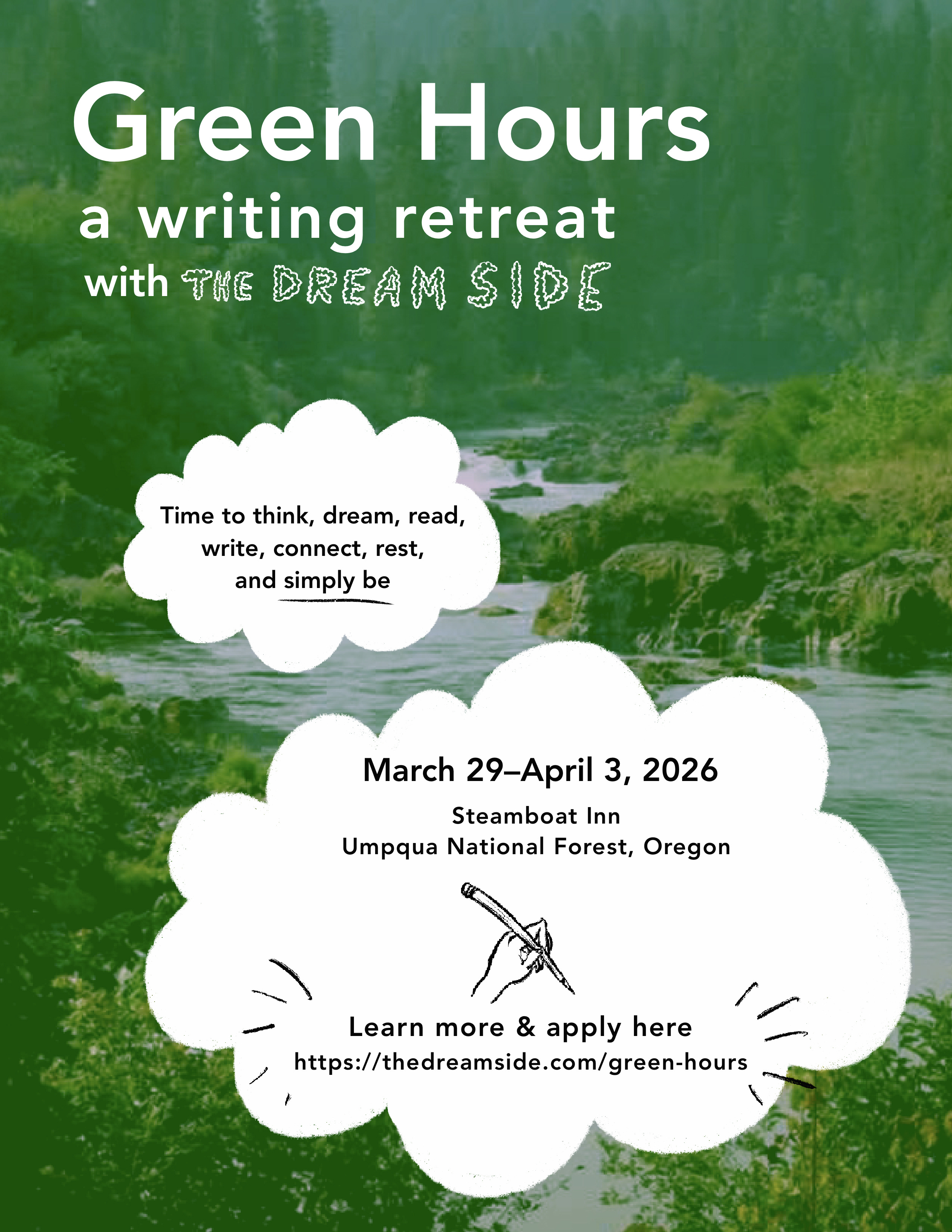
Will you help us spread the word about GREEN HOURS? Share the image above, or download a print flyer here, and pin it to a bulletin board at your favorite literary venue, coffee shop, or co-working space.

News & Links
We’re so excited to welcome our first group of students into our year-long novel generator Yes, Molecule! We were pleasantly overwhelmed by the response and created two cohorts. We’re grateful to all who applied!
Shruti is going to be in conversation with Sangamithra Iyer on January 12th at Green Apple Books. Shruti is also teaching a class on pleasure open to all BIPOC-identified writers with Kundiman on January 24th (online!)
Meng has a teeny tiny essay about Leanne Shapton’s Swimming Studies in the Winter (Sports!) issue of The Believer.
Meet Susanna and Rachel at the Palm Springs Readers’ Festival the weekend of January 30.
This April, join Rachel in celebrating the release of My Dear You! She will be in Boston (4/7, Lovestruck), New York (4/9, The Strand), San Francisco (4/16, Green Apple), and Los Angeles (4/23, Skylight).
Meng, I love that you're swimming in open waters. Expect a missive in the new year <3